Betaaljournaal 17
Newsletter Dutch Payments AssociationAfter a abundantly sunny summer vacation, most of our colleagues and members have returned to work. During the summer, we were particularly busy (together with members, DNB and McKinsey) with the major survey into the profits and losses of payment transactions.
Meanwhile, a great deal of consultation took place about the introduction of travelling in public transport with debit and credit cards, the distribution of cash, payment options for Ukrainians and debit card acceptance, to name but a few other issues. In addition, responses to various European consultations are being worked on.
Since lifting many corona restrictions we have seen a rise in the use of electronic payments. Much of this is reflected in this newsletter. We will also inform you about the rise of cardless payments and the highly desirable opportunities for payment institutions to exchange information about fraud. I wish you much reading pleasure.
The ‘meeting season’ is upon us again and we hope to meet many of you in person soon. I hope to see you at the online members’ meeting on the cost survey on 29 September and at other events we have in store.
Gijs Boudewijn, Director a.i.
- Use of e-wallets at the checkout continues to grow
- Trial at NS: travelling with a debit or credit card
- Debit Card Acceptance promotional material free of charge
- Agreements on sharing fraud information between payment institutions
- Activities for accessibility well on track
- ECPA puts quantum computing on agenda of Community meeting
- Consultations
- Six out of ten person-to-person payments are digital
- Figures
- Agenda
- Association news
Use of e-wallets at the checkout continues to grow
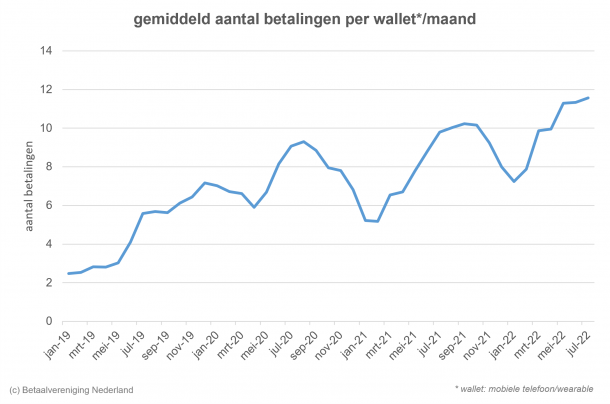
A quarter of all debit card transactions are now made with a smartphone or wearable (mobile NFC). For starters this is due to a growing number of e-wallet users. On top of that these users make more contactless payments with their e-wallets, about 12 payments per month. The average number of debit card payments per month for all consumers is 13 times, just under 11 of which are contactless. This suggests that mobile payers hardly use their physical cards anymore. For more debit card figures, go to www.pin.nl.
Trial at NS: travelling with a debit or credit card
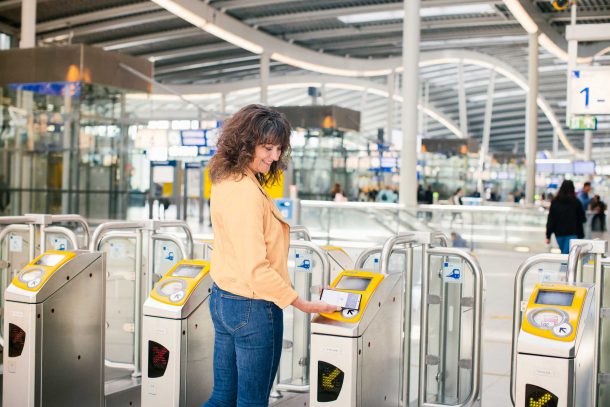
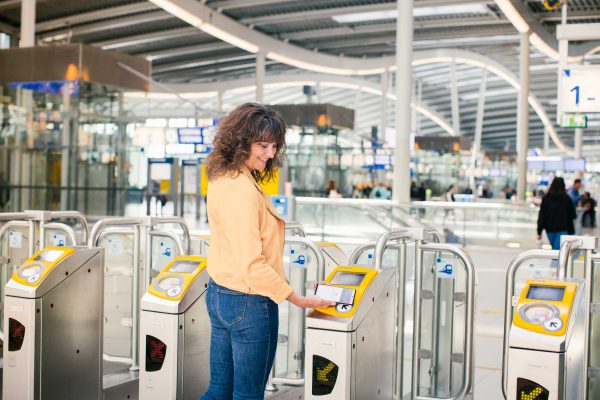
Some regional public transport operators already introduced travelling with a debit or credit card and this is slowly becoming a nationwide option. At the end of August national train operator NS started a trial whereby train passengers can check in and out with their contactless debit or credit card (also when using an e-wallet) at all NS train stations in the Netherlands. NS wants to make train rides even more convenient and flexible, for occasional travelers in particular. This offers an alternative for separate tickets or a special public transport travel card. Read more… (in Dutch).
Debit Card Acceptance promotional material free of charge
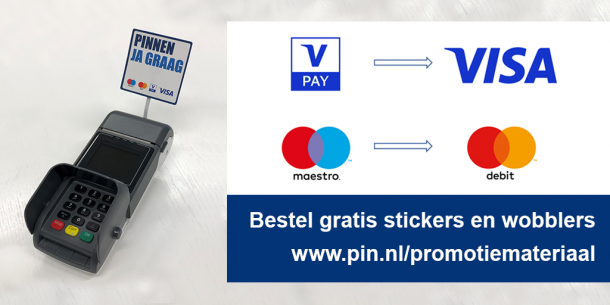
By the end of this year PoS payment terminal will not only accept Maestro and V PAY cards but also cards from Visa Debit and Debit Mastercard. At the moment this is mostly relevant for foreign card holders. In the future – when Dutch banks start issuing large numbers of Debit Mastercard and Visa Debit – it will also be relevant for Dutch card holders. Incidentally, at shop counters nothing will change for Dutch consumers. To emphasize that customers can pay with any card, entrepreneurs should show clearly that they accept these new brands. Therefore we provide free promotional materials, such as stickers and wobblers (in English and in Dutch). Entrepreneurs can also view the frequently asked questions about the new cards.
Agreements on sharing fraud information between payment institutions
 Earlier this year, through the Payment Institutions Advisory Council, payment institutions expressed a desire for further cooperation in fraud prevention. After all, just like banks, payment institutions are faced with increasing fraud, especially in the area of e-commerce. Banks have already made agreements to this end and they have developed a so-called PIFI protocol (protocol for incident warning between financial institutions) that was integrated into their KYC processes. This protocol has been approved by the Dutch Privacy Authority (AP). Payment institutions wanted something similar and asked the Betaalvereniging for help.
We set up a project group with several payment institutions and reached out to the AP to discuss how the General Data Protection Regulation (GDPR) allows to share fraud information between payment institutions. Unfortunately, it soon became clear that a PIFI-like protocol between payment institutions is not possible for all sorts of reasons. We therefore looked at existing initiatives for sharing fraud information. The Dutch police National Internet Fraud Reporting Office (called LMIO) came to mind as a promising option. LMIO already manages two online fraud repositories: Check vendor details | politie.nl and Known rogue traders | politie.nl(in Dutch).
The processes for maintaining these repositories need to be optimized and this will be done before the end of this year. For example, the link with the FIU (Financial Intelligence Unit) will be expanded and the API to both repositories will be improved. Payment institutions in the project group will then be able to integrate the information from these repositories into their own KYC processes. Eventually we want to call on all payment institutions integrate this information. After all, with more participants and more data, fraud prevention in the payments sector will continue to improve. Interested payment institutions should contact p.kleppe@betaalvereniging.nl.
Activities for accessibility well on track

Dutch banks want their services to be available to everyone, including vulnerable groups such as seniors and people with disabilities. In order to make banking services even more accessible to these groups, a collective action plan was approved in the National Forum on the Payment System (MOB) in mid-2021. The action plan is coordinated by a ‘Core Team’ comprising representatives of DNB, the secretary (an employee of the Payments Association) of the Interbank Working Group on Accessibility and Inclusion (WTI) and a representative of people in a vulnerable position. Both individually and collectively, banks take action to implement the action plan.
The action plan focuses on awareness of existing initiatives by banks for vulnerable groups, such as awareness of mobile care coaches, special customer service for vulnerable groups, courses, websites and telephone numbers. The action plan also aims to improve the services of banks through personal attention at the local level, where necessary. Finally, the action plan aims to identify the needs of vulnerable groups together with civic organisations and, if necessary, provide additional solutions.
Various actions have meanwhile been successfully taken. Read more about this in our report on the action plan and other accessibility initiatives (in Dutch).
ECPA puts quantum computing on agenda of Community meeting
ECPA puts quantum computing on agenda of Community meeting
Changes to the payment infrastructure have a long lead time. Early preparations are important to make the payment infrastructure quantum-proof. This starts with awareness. Oscar Covers from the Dutch Banking Association is the chairman of the Security Working Group of the European Card Payments Association (ECPA, of which the Payments Association is a member). He will underline at the North-American PCI Community meeting (13 – 15 September) that now is the time to start making the international payment infrastructure for card payments resistant to quantum computing. After all, the enormous computing power of quantum computers can break through the security of the current payment system. Opinions differ as to when quantum computers will become a real threat to safe and reliable payment transactions.
We have already started preparations in the Netherlands, but it is important to tackle this internationally. At the PCI Community meeting, international payment schemes such as Mastercard, Visa and AmEx are present as well as other important stakeholders in the international payment infrastructure (from evaluation laboratories to PoS/ATM suppliers to major retailers such as Walmart, Shell, Google, etc.). Oscar also represents the Payments Association in the Security Working Group.
Consultations
Until 12 September the European Payments Council (EPC) is holding a public consultation on the draft rulebook for the new SEPA Payment Account Access scheme (SPAA). The Open Banking Working Group of the Payments Association (chaired by Rob van Bergen from ING) is preparing a response that will be published on our website (in Dutch). The SEPA Payment Account Access scheme aims to create an ecosystem for open payments that adds value and fairly distributes value and risks across the chain. This is expected to give a positive impulse to open banking in Europe.
VAT fraud is and remains a concern. From 2024 onwards, payment service providers will therefore be obligated to report to the Tax and Customs Administration on certain cross-border payments they facilitate, to combat VAT fraud. Banks, payment institutions and ELMIs may all be affected by this new obligation. To set up a European database (the so-called Central Electronic System of Payment information – CESOP – in which payment data of cross-border transactions are stored), the Tax and Customs Administration is starting to provide information to payment service providers. In this way, the Tax and Customs Administration wishes to ensure a smooth implementation of the obligations for payment service providers.
For more information, please contact Ed Slob, account manager for financial institutions at the Tax and Customs Administration, at e.slob@belastingdienst.nl . A national information meeting will be held 13 September. The Commission will organize an (online) information meeting 23 September (TAXUD-CESOP@ec.europa.eu).
Incidentally, in January 2022 the Payments Association submitted a response to the consultation on this new legislation – drafted by the Dutch Banking Association (NVB) – in which it clarified the impact on the parties involved.
Six out of ten person-to-person payments are digital
 2021 recorded a total of 531 million person-to-person (p2p) payments, with a value of EUR 21.5 billion. Most p2p transactions are payments to family, friends, colleagues and other acquaintances (469.5 million transactions). The remaining transactions are payments for school, sports and other informal activities.
Consumers used cash in 39% of these transactions while the remaining majority of p2p payments were electronic, through online and mobile banking, often initiated through mobile payment requests. Electronic p2p payments had a value of EUR 14.9 billion (69% of the total value). In almost all population groups, electronic p2p payments are used more often than cash, with the exception of Dutch people with a relatively low level of education and those aged over 65.
This was published in the “PoS Payments 2021” report (in Dutch), issued in April by the Payments Association and DNB. This report contains a wealth of information about cash and electronic payments at checkout counters in the Netherlands. Highly recommended!
Figures
Agenda
- 29 September – Online members’ meeting about the survey on payment costs
- 9 October – Dutch SIBOS Drinks, Amsterdam
- 10-13 October SIBOS RAI Convention Centre Amsterdam
- 12-13 oktober – European Card Payment Association (ECPA) conference Amsterdam
- 13 October – Stakeholder meeting
- 17 November – General Members’ assembly with drinks, Amsterdam
Association news
Payvision has cancelled its membership of the Payments Association; the company ceases activities as a payment service provider.
Member Bulletins
In addition to this Betaaljournaal, the Dutch Payments Association issues Member Bulletins. These bulletins usually appear a few times a month and relate to a specific topic. If you are a member and you do not yet receive these bulletins, you can subscribe to the mailing list via secretariaat@betaalvereniging.nl .
Subscribe to Betaaljournaal
For the latest developments in payments, stay informed via Betaaljournaal. You can register here: