
Betaaljournaal 18
Newsletter Dutch Payments AssociationLast week I presented our final report of the “Study into costs and revenues of Dutch payment services in 2021” to our members and stakeholders. Because our biggest members were willing to share their data, we have a ‘fair picture’ of costs and revenues once again, for the first time since 2006. Based on this fair picture, the Payments Association and its members want to engage an open dialogue with everyone involved, in order to determine how the high-quality security, efficiency, reliability, accessibility and inclusiveness of our payment system can be funded future-proof.
Since the Russian attack in Ukraine, access to our efficient payment system has also been provided to over 50,000 Ukrainian refugees. Thanks to the combined efforts of our members, this became even easier and more accessible for these refugees in the Netherlands, starting early October. You can read more about it in this newsletter.
This newsletter also includes information on new promotional material about cash payments at retailers, ever-increasing online spending, the delayed migration of TARGET2, our presence at Sibos, the pilot “Getting Started in Digital Banking” for vulnerable banking customers and last but not least, fallback solutions for card payment malfunctions.
Gijs Boudewijn, Director a.i.
- Study into costs and revenues of Dutch payment services in 2021
- Instant Payments soon to be the new normal outside the Netherlands too
- More options for Ukrainians in the Netherlands to apply for payment accounts
- Project launch of ‘Digital fallback options for card payments infrastructure’
- Study on measures against card payment malfunctions
- New stickers ‘Contant geld ook welkom’ (‘Cash welcome’) available for free
- Online spending increases 9% to €16.1 billion in first half of 2022
- ECB postpones TARGET2 migration until March 20, 2023
- Sibos
- Banks collectively launch pilot ‘getting started in digital banking’
- Open Banking and SPAA-consultation
- Facts & Figures
- Agenda
- Association news
Study into costs and revenues of Dutch payment services in 2021
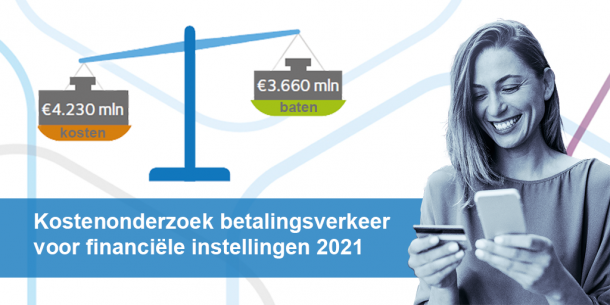
The Dutch Payments Association arranged a study on the costs and revenues of our payment system in 2021. The most recent major study dates back to 2005. The payments market has changed considerably since 2005: new payment products appeared while others disappeared and new kinds of participants joined this market. Most of all, the payment system now has a European scope and it has rapidly digitized.
The 2021 study shows that we have all improved efficiency enormously since 2005: in the year 2021, the sector processed 2.5 times more payments than it did in 2005, at roughly the same cost. At the same time we note that banks lose a hefty 570 million euros on payment services in 2021.
We are very grateful for the constructive contributions from stakeholders to map the costs and revenues, using a reliable methodology, as well as their feedback throughout the study. We also express our deepest gratitude to the Dutch central bank for their assistance and their extensive participation in the study. You can read the full report on the study here.
Instant Payments soon to be the new normal outside the Netherlands too

The European Commission has announced that Instant Payments will soon become mandatory for all providers of SEPA credit transfers, at no additional cost to users. To prevent errors and some forms of fraud, banks must provide a check on the name that goes with the payee’s IBAN to the payer.
In the Netherlands, Instant Payments have already been the new normal for several years. At almost all Dutch consumer banks, transfers via mobile and online banking are processed as Instant Payments, at no extra cost to the customer. Dutch banks are already fully reachable for Instant Payments, to and from all other banks in Europe that support them.
Checking the name with a payee’s IBAN has also been voluntarily provided by Dutch banks for many years, as the so-called IBAN-Name Check. This shows a warning if the payer enters an incorrect payee name with an IBAN, without disclosing the correct name. If so desired, the payer can ignore this warning and submit the credit transfer anyway.
More options for Ukrainians in the Netherlands to apply for payment accounts
As of Monday 3 October, Ukrainian refugees in the Netherlands have more options to apply for a payment account. They can now apply with documents that previously could not be verified by payment service providers. Currently, over 90% of all adult Ukrainian refugees in the Netherlands have a Dutch payment account. This was accomplished with a range of internationally acknowledged and valid English-language ID documents. The remaining small group of refugees in the Netherlands who could previously not open a payment account, now have additional options to apply for an account. These new possibilities are the result of close cooperation between the Ukrainian embassy, banks and other payment account providers, the Dutch Payments Association, the Dutch Banking Association (NVB), regulators and the government. Would you like to know more about all the available options? Then please read our press release of September 30th here.
Project launch of ‘Digital fallback options for card payments infrastructure’
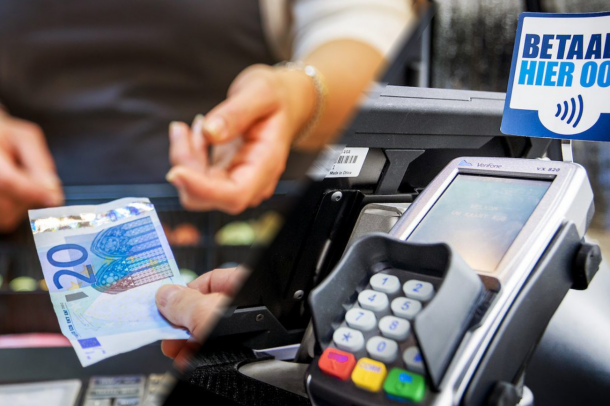
The Dutch payment card infrastructure is very reliable and has an availability rate of almost 100%. Due to the decreasing use of cash, there is an increasing amount of people who carry little or no cash. In the unlikely event of a card payment malfunction, cash is less and less a viable fallback option. For this reason, the so called “Covenant Contant” stipulates an agreement on digital fallback options in case the card payments infrastructure breaks down. On September 29, the kick-off meeting for the project “Digital fallback options for card payments infrastructure” was held at the Dutch Payments Association. Everyone in the card payment chain was represented: banks, card schemes, PoS terminal suppliers and retailers. The project’s aim is to ensure that by the end of 2023 every Dutch retailer, if he so desires, can use a fallback solution should the card payments infrastructure break down.
Study on measures against card payment malfunctions
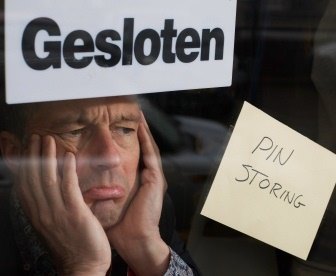
During the summer of 2022 a telephone survey was conducted among more than 450 businesses with PoS terminals in order to gain more information about card payment malfunctions. They were asked how they prevent PoS terminal outages themselves and what they do if a customer can’t pay with cash during an outage. The survey shows that the yearly number of card payment malfuntions is limited. In fact, 38% of the respondents reported that they never experienced a malfunction. Problems with internet access or data connections and malfunctions of payment terminals are cited as the most common causes of an outage.
While cash is still seen as the major fallback option for many business owners, smaller business owners in particular are also using regular credit transfers or mobile payment requests as a fallback. Sadly, these solutions are less suitable for big busy stores, such as supermarkets. There are currently few alternatives available for these bigger shops. Our project “Digital fallback options for card payments infrastructure” aims to ensure that this group of retailers has access to adequate fallback options alongside cash. You can read more about this survey here in Dutch.
New stickers ‘Contant geld ook welkom’ (‘Cash welcome’) available for free
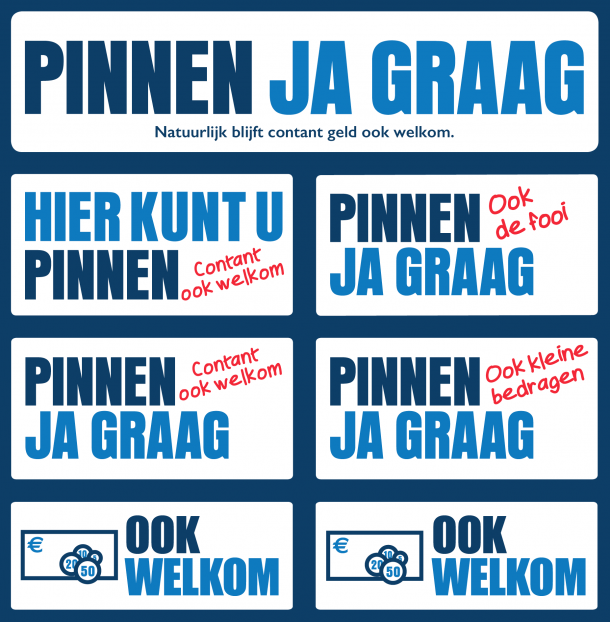
To make customers aware that they can pay with cash, retailers can order new stickers in the PIN.NL webshop from now on. There are several variants so shop owners can choose the sticker that best matches their business. All the variants are also available on a single sheet. The sticker sheets can be ordered free of charge on Promotiemateriaal – PIN.NL. They are automatically added to orders for other stickers. Last but not least, the stickers have been supplied to trade associations and payment terminal suppliers for distribution to their members and customers.
Online spending increases 9% to €16.1 billion in first half of 2022
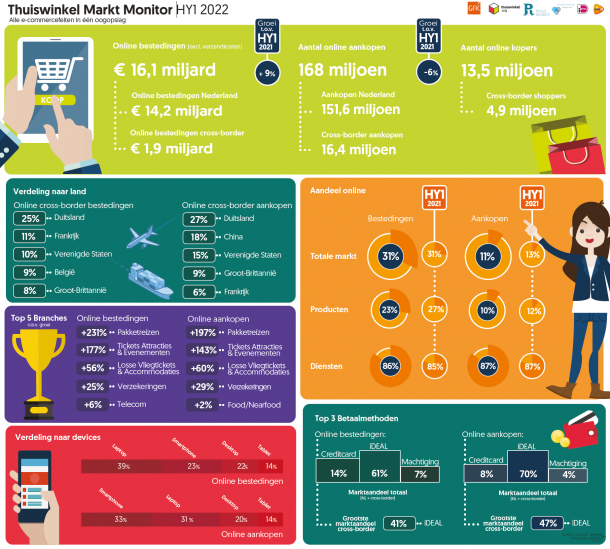
In the first half of 2022 online expenditures by Dutch consumers reached €16.1 billion. That is a 9% higher than in the first half of last year. The growth is driven by a strong increase in services, namely +86%.
“The strong growth in services is mainly caused by a rise in ticket sales for events and theme parks, as well as package tours and airline tickets. Online ticket purchases in Q2 nearly doubled compared to the same period in 2021. This correlates with six months without corona restrictions,” says Marlene ten Ham, director at Thuiswinkel.org. Likewise, the online spending on products is higher than pre-corona levels, although we do see a decrease by -11% in comparison with the same period last year. This is shown in the latest statistics from Thuiswinkel Markt Monitor. To read more about the latest numbers from Thuiswinkel Markt Monitor, please click here (in Dutch).
ECB postpones TARGET2 migration until March 20, 2023
The ECB’s Governing Council decided October 20th to postpone the go-live of the new T2 platform, until 20 March 2023. November 21st was the original launch date. The postponement decision was primarily motivated by banks’ need for longer and better testing in a stable environment. Four extra months will help to ensure the stability of the new system and will allow users to be better prepared. As a result, the transition to the new T2 platform will be smoother. The Dutch banks share the underlying concerns leading to the decision.
For banks, the T2 implementation includes a new account system at the central bank, custom connections and implementation of the ISO-20022 messaging standards. The postponement has wide-ranging implications. Similarly, SWIFT has decided to delay the introduction of ISO-20022. With the postponement, the Dutch interbank consultation structure for the T2 implementation remains intact for the time being. The Dutch Payments Association will continue to coordinate the end-to-end tests.
Sibos
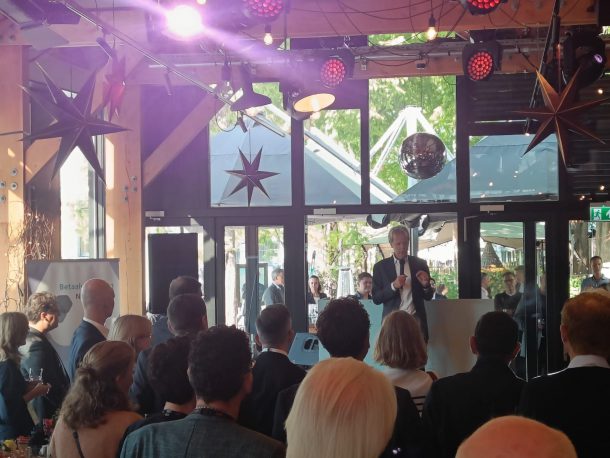
On October 10th, 2022, the Sibos Congress, formerly known as SWIFT International Banking Operations Seminar, was opened by Queen Maxima in the Amsterdam RAI, where several thousand financial experts from around the world met. The Congress brought a large number of individuals from the field of European payments together. However, payments professionals from the Dutch Payments Association’s network and the four largest Dutch banks met earlier, in Strand Zuid, directly adjacent to the conference venue, on the day before the congress started. During this reception, there was an opportunity to catch up on old connections and discuss new developments in the industry. Dutch Payments Association President Gottfried Leibbrandt welcomed those in attendance with a speech of greetings. Afterwards, there was an opportunity to catch up with each other in the autumn sunshine. Moreover, congress attendees were also able to pick up their badges for the following day. The gathering was very well-attended and had an energetic atmosphere that was the kick-off to a busy week full of information exchanging and networking.
Banks collectively launch pilot ‘getting started in digital banking’
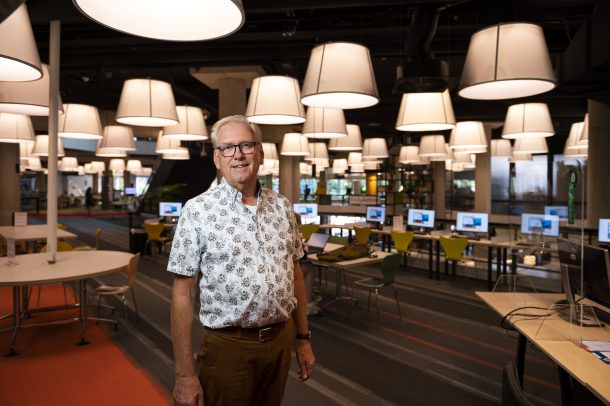
“Alone you go fast, but together you go faster.” A motto that propels banks to take joint steps on accessibility and inclusivity. Most recently, ABN AMRO, ING and Rabobank joined forces. A pilot was launched in October in three cities where everyone with questions about banking can get help. This can be done at a special walk-in consultation desk in the central public library in Rotterdam, Overvecht public library in Utrecht and the public library in Deventer. More than 3 million Dutch people in vulnerable positions are targeted by the pilot. They include seniors, people with low literacy levels and people with physical or mental disabilities. The volunteers, retired employees of large banks, are available for 2 hours a week since the pilot was launched. They direct people to the right channels and they help them to formulate their questions. The volunteers provide information themselves whenever possible and always refer people to certified financial experts for complex questions. They always provide brand neutral information, regardless of the bank of the customer.
Open Banking and SPAA-consultation

With the arrival of the revised Payment Services Directive (PSD2), licensed third parties have free access to a consumer’s payment account after explicit consent by the account holder. This has become known as Open Banking. Third parties can thereby deliver account information or payment initiation services to consumers. For example, they can display balances in payment accounts at various banks in one simple overview, or they can categorize transactions automatically and provide tips on saving money. Earlier this year, the Dutch Payments Association started an Open Banking study group to facilitate cooperation in the Dutch industry and follow (European) initiatives, among other goals.
One of those European initiatives is the development of the SEPA Payment Account Access (SPAA) scheme. PSD2 has not led to any major developments in the market thus far, so the industry is jointly looking ahead. Under the auspices by the European Payments Council (EPC), banks and payment institutions are working together to develop new premium services and put them into an agreement system (a scheme). Third-parties can then offer more services to customers and banks can receive a fee for providing access and for maintenance of the gateway to the payment account. The Dutch Payments Association is closely involved in this initiative along with the Open Banking Study Group and through EPC’s SPAA Multi Stakeholder Group in Brussels. In September the study group responded to EPC’s SPAA rulebook consultation, the response can be found here.
Facts & Figures
Agenda
- 27 oktober – Advisory Board (Payment Association)
- 15 november – Autumn meeting Social Consultation on Payments (MOB) at the Dutch Central Bank (Spaklerweg in Amsterdam).
- 17 november – Board Meeting and General Members’ assembly
- 24 november – Advisory Board Payment Insitutions
- 8 december – Advisory Board
- 19 december – Board Meeting
Association news
On Thursday, November 17th from 15:00 to 17:00, the Dutch Payments Association will hold its semi-annual General Members’ assembly in the Auditorium of Symphony Offices, followed by an educational and interactive event on Open Banking. This General Members’ assembly is a private meeting, only for members. Please register here.
Member Bulletins
In addition to this Betaaljournaal, the Dutch Payments Association issues Member Bulletins. These bulletins usually appear a few times a month and relate to a specific topic. If you are a member and you do not yet receive these bulletins, you can subscribe to the mailing list via secretariaat@betaalvereniging.nl.
Subscribe to Betaaljournaal
For the latest developments in payments, stay informed via Betaaljournaal. You can register here: