Betaaljournaal 24
Newsletter Dutch Payments AssociationIt is almost time for our annual conference; less than a month to go! It should not be a surprise that this year’s conference is all about accessible and inclusive payments. Last week, we already held a meeting with our members on the European Accessibility Act.
However, all other developments in payments continue unabated, starting with preparations for a possible introduction of a digital euro. The European Central Bank’s board decided last week to move to the next stage of preparations. The European Commission presented a legislative proposal to ensure sufficient availability and acceptance of cash, alongside a legislative proposal for a legal framework of the digital euro. Closer to home, the Ministry of Finance is working on a specific Dutch bill on cash. Furthermore, it is now possible to make contactless cash withdrawals at Geldmaat’s latest ATMs, ‘tap-for-cash’.
Laws and regulations to keep cash available for vulnerable groups fortunately do not hinder further digital developments. For instance, Europe is pushing ahead with the successors to PSD2, with the PSR and PSD3 and with the Open Finance Framework. Together with Thuiswinkel.org and Currence, we have published the figures on online transactions and spending in e-commerce for the first half of the year. Our members will soon be able to follow these closely in a new digital dashboard for the Thuiswinkel Market Monitor.
I hope to see many of you at our annual conference on 15 November. For now, I hope everyone will enjoy reading this new edition of our Payment Journal.
Gijs Boudewijn, managing director
- SEPA migration ISO 20022 postponed until 17 March 2024
- Invitation Annual Conference
- Banks sign Alliance Digital Society’s Digital Inclusion Manifesto
- Meeting with members on accessibility requirements EAA
- Developments for a digital euro
- Job offer for Product Consultant cashless payments
- Tapping for cash at Geldmaat
- PSR and PSD3
- European legislation on availability and acceptance of cash
- Online purchases unchanged in first half of 2023
- Newsletter Accessible Banking
- Geldland
- Agenda
SEPA migration ISO 20022 postponed until 17 March 2024

On 24 October 2023 the Payment Scheme Management Board (PSMB) of the European Payments Council (EPC) has decided to postpone migration to the 2019 version of the ISO 20022 XML standard for SEPA payment messages, until Sunday 17 March 2024. All changes for the 2023 rulebook will also be postponed until 17 March 2024.
Invitation Annual Conference
On Wednesday 15 November we organise our Annual Conference; this year’s topic is ‘accessible payments’. How can we familiarise people with digital anxiety with banking apps? What innovations can provide better assistance to target groups that need this? What can artificial intelligence deliver? You will see several demos. We will also talk about the programme for accessible banking that we carry out with our members and with the NVB, and about the challenges for the European Accessibility Act that we face as a sector. Our master of ceremonies will be Donatello Piras.
It is time for accessibility. We greatly appreciate your attendance!
Location: ING Cedar, Bijlmerdreef 106, Amsterdam
Time: 13h30 – 17h00 followed by a snack and drink (walk-in from 13h00)
The schedule is available on the Payments Association’s website
Banks sign Alliance Digital Society’s Digital Inclusion Manifesto
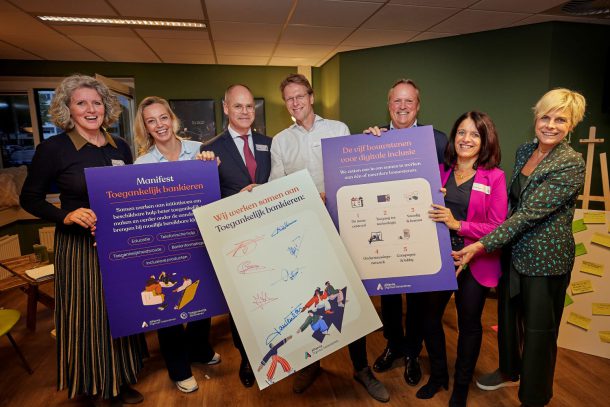
The four larger Dutch banks, the Dutch Banking Association (NVB) and the Dutch Payments Association jointly signed the Digital Inclusion Manifesto of the Alliance Digital Living together in Almere on October 12th, 2023. The signing of the manifesto took place during a dialogue session led by Laurentien van Oranje with experience experts, representatives of social interest groups and employees and directors of banks.
Meeting with members on accessibility requirements EAA
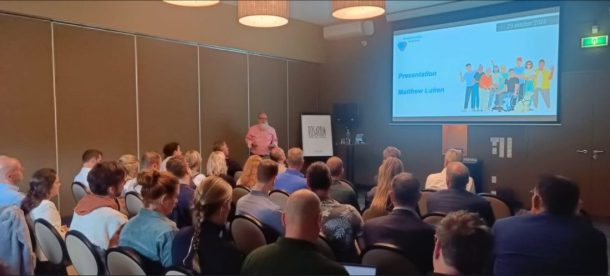
On 23 October we had a meeting with members on the European Accessibility Act (EAA) in Amsterdam. Matthew Luken, former VP Digital Accessibility at US Bank, took over 40 attendees through his experiences of applying accessibility requirements to US Bank’s digital services.
Luken focused on how he built the organisation from the inside out to spread accessibility into the capillaries of the organisation. He mentioned many recognition points, such as: how do you ensure accessibility in your organisation? How do you ensure managerial commitment? Above all: how do you ensure good testing processes for your websites and apps? Luken provided the audience with interesting perspectives and points of action.
Prior to Luken’s presentation, Michel van Bommel of the Payments Association talked about the specifications and requirements of the EAA and about the Payments Association’s activities for this topic.
We can look back on a successful meeting.
Developments for a digital euro
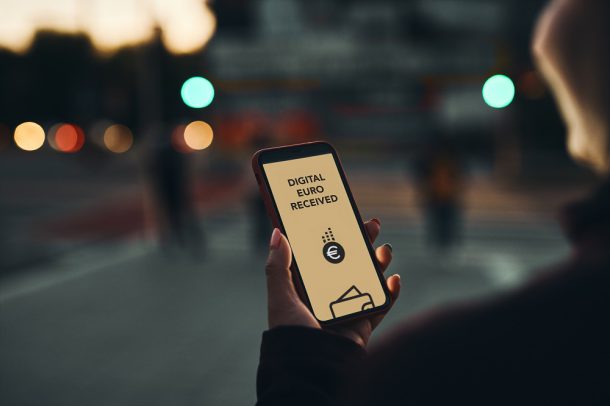
Preparations for a possible digital euro will enter a next phase on 1 November 2023. The Governing Council of the European Central Bank (ECB) announced this on 18 October. Amongst others, the ECB will select service providers to possibly develop the necessary infrastructure and will prepare for a future decision on issuing a digital euro.
The European Commission (EC) and the ECB have long been preparing for the possible introduction of a digital euro as a retail payment instrument. With the increasing digitisation and the associated declining relevance of cash payments, they also want to offer citizens and businesses a euro in digital form. In June, the Commission already published a proposed legal framework for a digital euro.
ECB decision-making on the actual construction and implementation of a digital euro can only take place after the final adoption of the legislation proposed by the EC. After this decision-making, any implementation will take two to three years. Consequently, a digital euro can certainly not be introduced before 2027.
The Payments Association is closely monitoring developments. We are committed to providing critical feedback on behalf of our members. We offer guidance to our members in further developments for the design and implementation of a digital euro whose introduction is not yet certain. As Commissioner McGuiness stressed, “We are at the beginning of a long democratic process.” With the upcoming transfers of the EU presidency to non-euro countries, it is uncertain how fast this topic will progress.
Job offer for Product Consultant cashless payments

Looking for a dynamic job in payments? We are looking for a Product Consultant to manage and expand Digitaal Incassomachtigen (digital mandates for direct debits)! Work with experienced colleagues and play a leading role in the collective Dutch payments infrastructure.
Ready for this challenge? Apply now! Not the job for you but you know the perfect candidate? Share this opportunity in your network!
Tapping for cash at Geldmaat
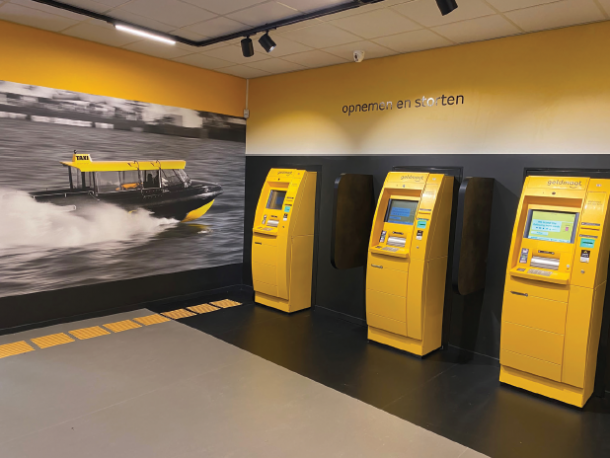
From now on, you can withdraw cash by tapping your card, smartphone or smartwatch on Geldmaat’s latest ATMs. You no longer need to fully insert a debit card into the ATM, you can simply tap your card, phone or smartwatch against an NFC scanner (with Near Field Communication), provided that your bank supports this.
Currently, most banks support this for physical contactless debit cards. It does not yet work with virtual cards from many banks on smartphones and smartwatches, with a few exceptions.
It is expected that eventually you will be able to use contactless debit cards from all banks to make contactless withdrawals at Geldmaat, including virtual cards on smartphones and smartwatches. Ask your own bank what is already possible or just try it at one of Geldmaat’s new ATMs.
Geldmaat’s new ATMs have a contactless NFC scanner neatly integrated in the machine. A working NFC scanner is surrounded by a green light and shows the contactless payment symbol. These new ATMs are already in all Geldmaat shops. Over the next year, they will gradually also be installed in normal shops and outside in facades. Contactless card readers are less vulnerable and less prone to failure than card readers that requires a card to be fully inserted.
PSR and PSD3
In our previous Payment Journal, we reported that on 28 June, the European Commission published two proposals following a PSD2 review, for the so-called PSR and PSD3. In early October, the Payments Association responded to these proposals, together with members and the Dutch Banking Association. The Dutch Payments Association welcomes the Commission’s legislative proposal in general; it will lead to less fragmentation between member states. However, particularly in the domain of Open Banking and consumer protection, we see room for some improvements.
Follow the consultations on PSR and PSD3 on our website, supplemented by our reactions.
European legislation on availability and acceptance of cash

The European Commission (EC) has proposed a regulation on euro banknotes and coins as legal tender. That regulation consists of two parts:
- Acceptance of cash payments;
- Access to cash.
Betaalvereniging Nederland believes that in principle, cash acceptance should be market-driven. Retailers know best which payment methods to offer to their customers. For specific sectors stricter rules can apply. The EC should take into account the local needs of member states. After all, member states differ in the degree and manner of payment digitization. The EU proposal for cash access already fits well with the Dutch situation.
The bill also outlines the supervision of both parts. The Payments Association is satisfied that the regulation leaves room for member states to take measures when actual practices are not in line with the regulation. Each member state can decide which measures are most useful, depending on the specifics of the national payment market. The EC should only be allowed to override a member state’s decision in very specific situations.
Online purchases unchanged in first half of 2023
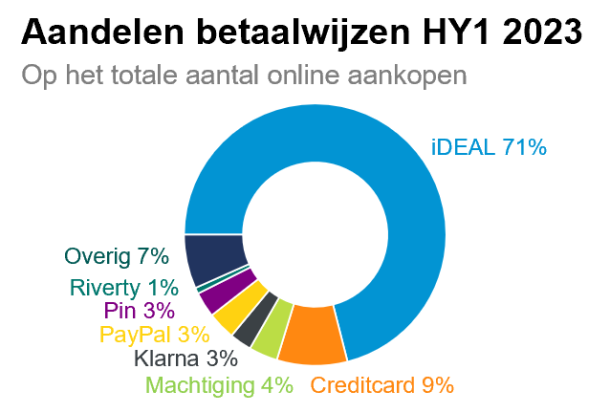
The number of online purchases by Dutch consumers in the first half of 2023 was the same as in the previous half-year. Overall online spending rose 2%, mainly due to higher online spending on services, such as travel, accommodation and events. Online spending on products dropped, especially on appliances, clothing and personal care.
Many more insights on developments for e-commerce payments in the first half of the year in a joint post by Thuiswinkel.org and the Dutch Payments Association. It also includes a clear infographic.
Newsletter Accessible Banking

Are you already familiar with the important initiative by ABN AMRO, ING, Rabobank and de Volksbank to make banking more accessible for everyone? The Accessible Banking programme is committed to helping people in vulnerable positions and aims to make banking and payments more accessible. The programme is coordinated by the Payments Association and the NVB.
Stay informed about the latest initiatives, collaborations and measures by signing up for the Accessible Banking newsletter.
Agenda
- November 15th – General Members’ Assembly and subsequent yearly conference of the Dutch Payments Association
- November 27th – Digital Inclusion Day
- November 28th – Maatschappelijk Overleg Betalingsverkee
Ledenbulletin
In addition to this Betaaljournaal, the Dutch Payments Association issues Member Bulletins. These bulletins usually appear a few times a month and relate to a specific topic. If you are a member and you do not yet receive these bulletins, you can subscribe to the mailing list via secretariaat@betaalvereniging.nl.
Subscribe to Betaaljournaal
For the latest developments in payments, stay informed via Betaaljournaal. You can register here: