
Betaaljournaal 20
Newsletter Dutch Payments AssociationAt the end of January DNB (the Dutch national bank) published a major study on the effects of digitization in payments: Digitization of the payment system: a solution for some, a challenge for others. The study shows that digitization has brought a lot to society but that some people struggle with digital services and cannot autonomously manage their daily digital banking affairs. This includes some elderly people, people with low literacy, people with disabilities and people with a migration background.
We welcome this report. Financial services should be accessible to everyone and the report identifies where we need to focus our efforts, in close collaboration with social interest groups. The Dutch Banking Association and the Dutch Payments Association have published a response to the report on behalf of their members, with clear short and long term commitments. You can read more about this in this newsletter.
For us, the commitment means that we will continue to focus on accessible payment services with more pace and resources, to intensify collaboration between our members and social organizations and to accelerate projects.
The ‘commitment’ was drafted with four major banks. We cordially invite other members to join the commitment and the long term program!
Gijs Boudewijn, Managing Director
- Banks: more support for customers struggling with digitization
- Physical and online payments together above pre-COVID levels
- Checking into trains with debit & credit card or smartphone
- Green light for TARGET2 Migration on 20 March
- Meet Geldland
- The Dutch are ready for ‘new’ debit cards
- Dutch Payments Association and its members respond to EC’s proposed laws and regulations for Instant Payments
- Consultation SPAA Scheme Rulebook
- Finland and the Netherlands lead with card payments in euro zone
- Figures
- Agenda
Banks: more support for customers struggling with digitization
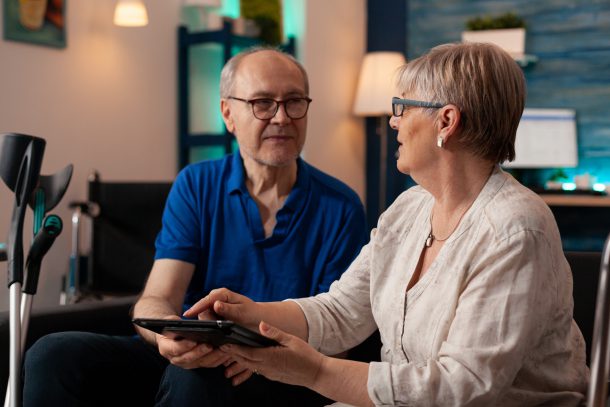
ABN AMRO, ING, Rabobank, and de Volksbank will provide extra support to customers who struggle with digital services. Research by De Nederlandsche Bank (DNB) shows that people in vulnerable positions typically need human, personal assistance and non-digital instruments. In a ‘Commitment’ published on 30 January, banks guarantee that digitally challenged customers can continue to use non-digital basic banking services. The banks will jointly work with other organizations to reach these customers with their support provisions. There will be a long-term program with many activities from the Dutch Banking Association (NVB) and the Dutch Payments Association, designed in collaboration with consumer interest groups. Amongs others, a trial with public libraries will be expanded to at least ten locations where bank customers can ask for advise and support. A common ‘accessibility road’ will guide bank customers to suitable assistance and services. Other members of the NVB and the Payments Association are encouraged to join the program.
Read more about banks helping their customers with digital services
Physical and online payments together above pre-COVID levels
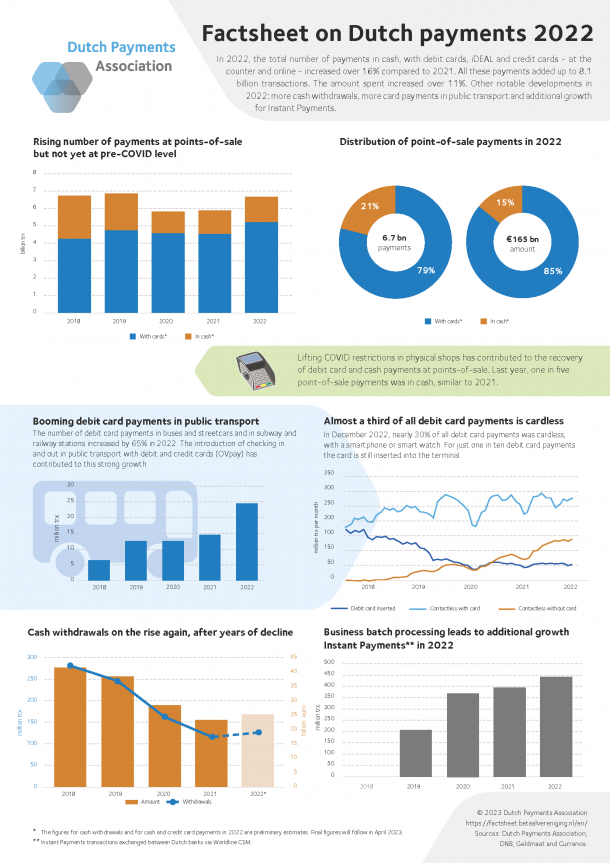
In 2022, the total number of payments in the Netherlands with cash, debit cards, iDEAL, and credit cards, both in physical shops and online, showed an increase of 16% compared to 2021. The amount spent with these payment methods increased by 11% to nearly €282 billion. Physical payments made a comeback last year compared to online payments, with an increase of 18%. Online payments increased by 7%. Cardless payments via smartphone or smartwatch are becoming increasingly popular and accounted for 30% of all debit card payments in December 2021. The number of debit card payments in public transport increased by 65% in 2022, thanks to the introduction of checking in and out with payment cards. The number of cash withdrawals at ATMs increased by 8% and the amount withdrawn increased by 13%.
Read more about physical and online payments in 2022
Checking into trains with debit & credit card or smartphone
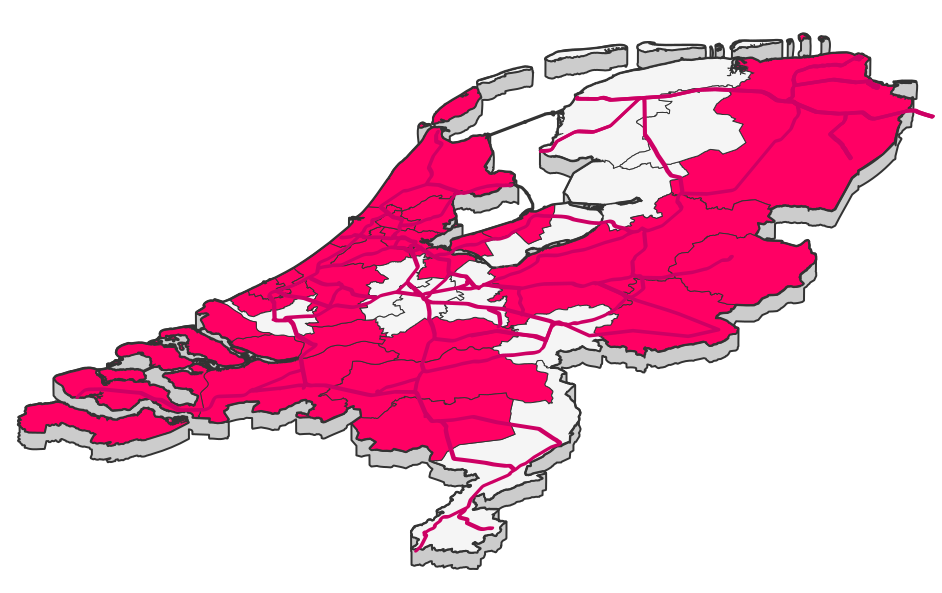
Since 31 January 2023, the National Dutch Railways (NS) offers train passengers the option to check in and out with a debit and credit cards (including virtual cards on smartphones or smart watches), in addition to the existing option of the OV-chipkaart (the Dutch national travel card). The NS started a pilot at the end of August with over 3,000 travelers, to fine-tune the technology before the full scale launch.
The nationwide roll-out of new payment options in public transport (the OVpay program) is steadily progressing. More and more regional and local public transport providers are joining, such as recently the major carriers Qbuzz and Arriva.
Hopefully by the end of March it will be possible to travel with a debit or credit card at all Dutch public transport providers (for bus, tram, subway and train). For the time being, this will allow debit and credit card holders to travel single journeys at full fare only. Eventually it will also be possible to use payment cards to travel with discounts, such as age discounts or off-peak hours discounts.
Green light for TARGET2 Migration on March 20

On Friday, February 10, the Market Infrastructure Board (MIB) of the European Central Bank (ECB) issued a positive opinion on the consolidation of TARGET2 and T2S to ‘T2’ on 20 March 2023. The settlement of euro securities transactions and high-value euro payments will then be carried out through a single supporting platform. In addition, the current MT messages for payment transactions will be migrated to the ISO 20022 standard. A final go/no-go decision from the Governing Council of the ECB is still pending until February 24.
The migration will take place on March 20 using a ‘big bang’ scenario, for all involved systems at once. The big bang migration was postponed in November 2022 to provide more time to all the participants to successfully complete testing in a stable environment.
Meet Geldland

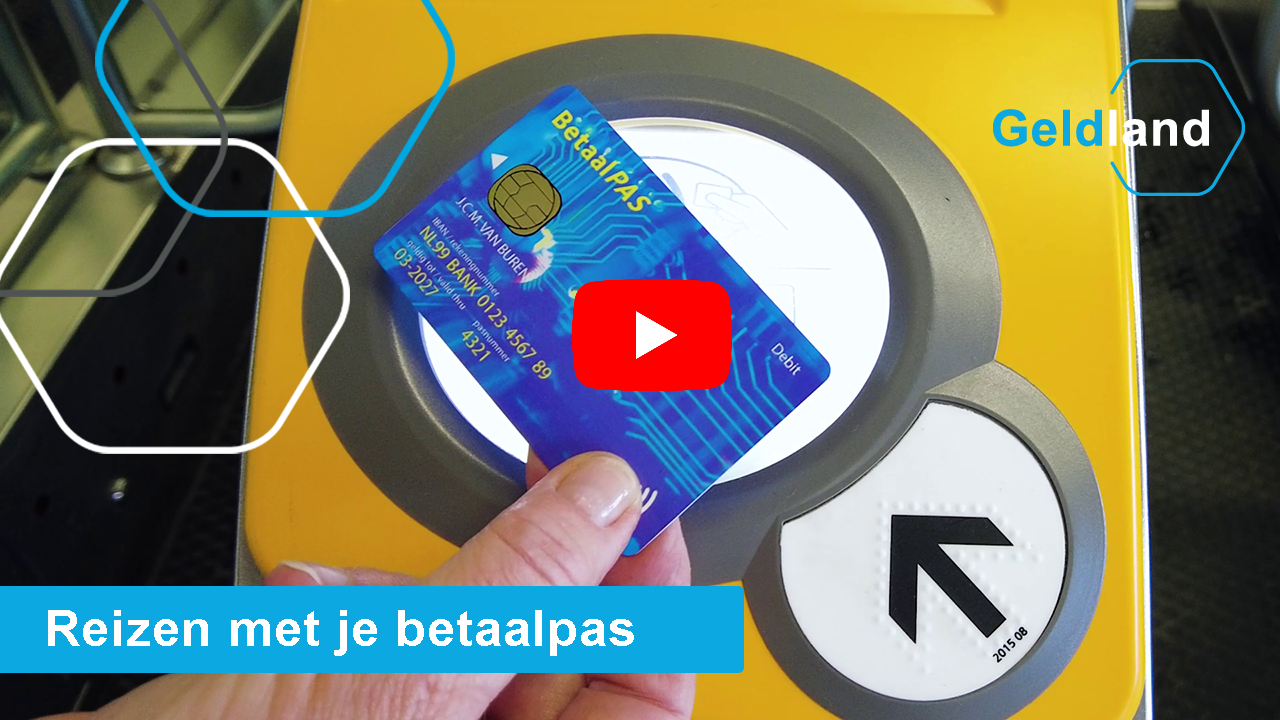
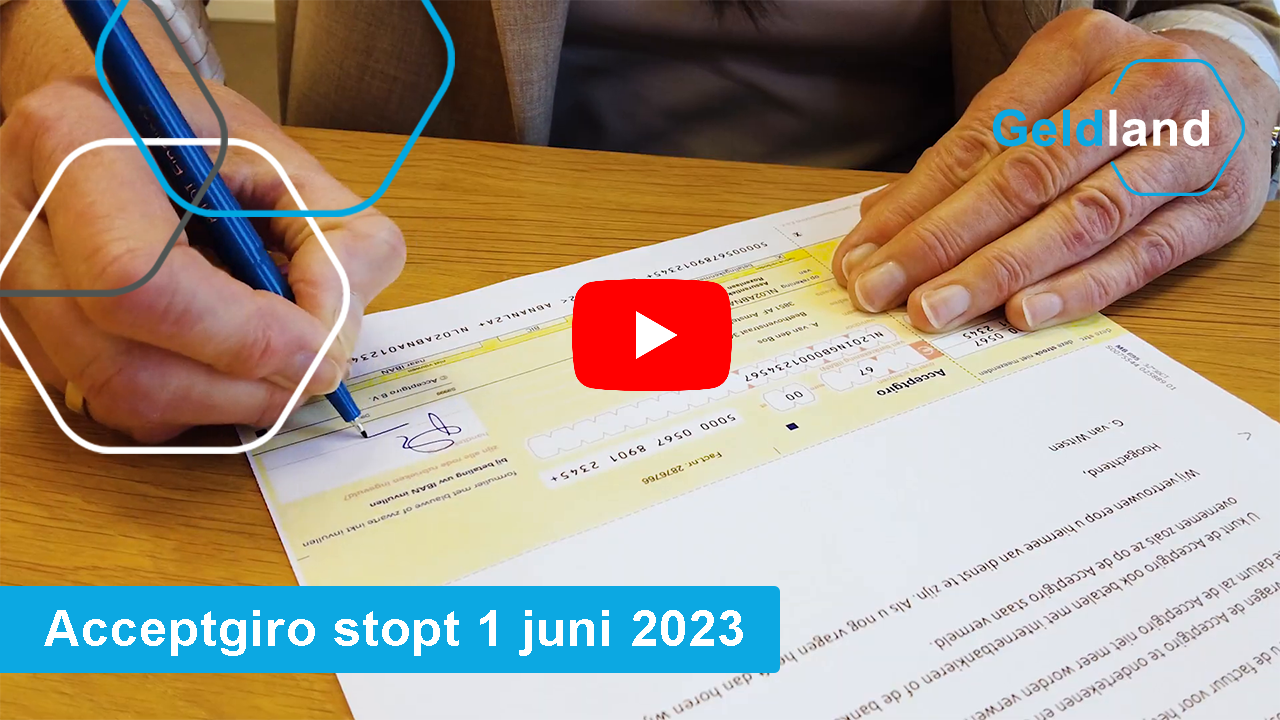
We launched Geldland on January 10. With Geldland we provide information to consumers about various aspects of the collective Dutch payment system. Geldland illustrates everything that is involved in daily payments. We have started a YouTube channel with (monthly) videos in Dutch. In addition, there will be a concise website with background information and the latest news on payments for consumers. Our first two videos are about OVpay (checking in and out of public transport with a debit or credit card) and Acceptgiro (standard Dutch paper payment orders for billing and donations that will soon be phased out). In the near future, topics such as ‘paying on vacation’ and ‘new debit card brands’ will be on the agenda. To follow Geldland subscribe to our YouTube channel.
Watch our first two videos here:
 |
 |
The Dutch are ready for ‘new’ debit cards

The Dutch Payments Association has completed the Debit Card Acceptance project (DCA). After a successful upgrade or replacement of 425,000 payment terminals, foreign visitors and Dutch citizens with cards branded Debit Mastercard or Visa Debit, can now easily pay in most Dutch shops. This project was a collaboration between banks, point-of-sale terminal suppliers, transaction processors, Visa, Mastercard and of course the Dutch Payments Association.
Over the next few years, 30 million Dutch debit cards from Maestro or V PAY will gradually be replaced by new debit cards from Visa Debit or Debit Mastercard. Until then, cardholders with a valid V PAY or Maestro card can continue to make payments and withdraw cash anywhere in Europe.
Both Debit Mastercard and Visa Debit can now be used for debit card transactions on most payment terminals in the Netherlands. An expected 90% of all terminals will be updated or replaced by the end of March. An estimated seven out of ten terminals that are not yet updated or replaced support Visa Debit and Debit Mastercard nevertheless, because they already accepted credit cards before the DCA Project was launched.
The Dutch Payments Association will set up an incident hotline to ensure smooth acceptance at points-of-sale. We will also raise awareness among merchants about the importance of replacing outdated terminals and the availability of point-of-sale information materials. Business owners can order these materials on PIN.NL, to display at the checkout, showing which card brands customers can use.
Read more about the completion of the DCA Project
Dutch Payments Association and its members respond to EC’s proposed laws and regulations for Instant Payments

The European Commission has submitted proposals for legislation on Instant Payments, with the aim to make new payment methods based on Instant Payments, easily and widely available. The Netherlands was the first country in the eurozone to introduce Instant Payments on a large scale and is still one of the market leaders for Instant Payments. Dutch banks and payment institutions have executed close to 1.5 billion Instant Payments between different banks, gaining extensive knowledge and experience.
On behalf of our members, we have responded to the EC’s proposals and argued for improvements to make these laws and regulations easier and better enforceable. The EC’s proposals include complex requirements for ‘confirmation of payee’ (CoP) with Instant Payments, also known as the IBAN-Name check in the Netherlands. We point out opportunities to offer this check in a simple, accessible and secure way, without infringing on the privacy of consumers or the commercial interests of businesses.
Read more on our response to the EC’s proposals
Consultation SPAA Scheme Rulebook
The European Payments Council (EPC) is launching a public consultation on the expansion of version 1.0 of the SEPA Payment Account Access (SPAA) scheme rulebook (EPC012-22 version 1.0), about the use of Strong Customer Authentication (SCA). The outcome of this new targeted public consultation will be incorporated into a revised version of the SPAA Scheme Rulebook. This public consultation will last for 90 days, until 15 March 2023.
Finland and the Netherlands lead with card payments in euro zone
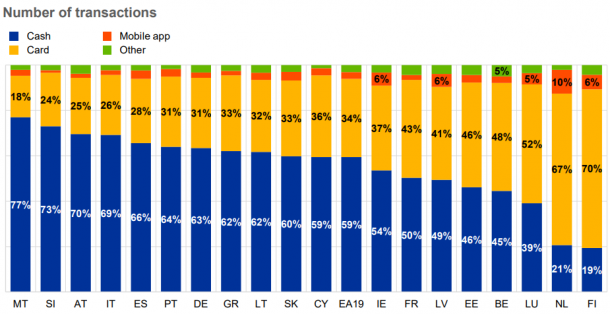
According to a recent study by the European Central Bank (ECB), Finland and the Netherlands are leading the way in card payments in the euro zone. The study shows that Finns pay slightly more often with their debit card, smartphone, or smartwatch than the Dutch. In the Netherlands, about one in five payments at physical counters is still settled in cash, while in the entire euro zone, three in five payments are settled in cash. In major euro zone countries such as Germany, Italy and Spain, cash payments are still more frequent than the euro zone average.
The number of debit card payments in the Netherlands has increased significantly in the past year, after two COVID-19 years with restrictions in physical stores. This year, more than 5 billion debit card payments were made within one calendar year for the first time. About 30% of all Dutch debit card payments are now made with a smartphone or smart watch.
Check out the annual report Betalen aan de Kassa (Payments at the Cash Register) of the Dutch Payments Association and De Nederlandsche Bank (DNB).
Read more about card payments across the euro zone
Figures
Agenda
- Beginning of March – Roadmap of the Dutch Payments Association
- March 6th – Giraal Stakeholder Forum / Card Forum
- March 16th – Euroforum convention on
the future of payment transactions(in Dutch) - April 18th – Open Banking event “SPAA: open access beyond PSD2”
- End of April – Annual report of the Dutch Payments Association
- May 17th – General Members’ Assembly
Member Bulletins
In addition to this Betaaljournaal, the Dutch Payments Association issues Member Bulletins. These bulletins usually appear a few times a month and relate to specific topics. If you are a member and you do not yet receive these bulletins, you can subscribe to our mailing list via secretariaat@betaalvereniging.nl .
Subscribe to Betaaljournaal
For the latest developments in payments, stay informed via Betaaljournaal. Subscribe here to Betaaljournaal