Betaaljournaal 21
Newsletter Dutch Payments AssociationOnce again, there was plenty of news about payments between Carnival and Easter. The Payments Association and DNB released their annual report on Payments at Points-of-Sale, the Thuiswinkel.org Market Monitor 2022 was published, we published our updated roadmap, the EPC posted a profile of Dutch payments on its website and we held a well-attended public event on Open Banking and SPAA.
A very large operation took place relatively silently across Europe: the migration of TARGET2 to the new T2 system for real-time gross settlement of euro payments between banks by the Euro system. That migration was as impacting for payment service providers as the introduction of SEPA in 2014. Another recent development on a European scale was the European Commission’s public consultation on its legislative proposal to essentially make support of Instant Payments mandatory for payment service providers in the EU.
Acceptgiro is a purely domestic Dutch paper payment instrument. This iconic payment form will soon be phased out in an increasingly digitised world, after almost 50 years in service. In this Betaaljournaal, we revisit the illustrious history of Acceptgiro.
I hope you will enjoy this newsletter and I wish you pleasant remembrance days and holidays. We expect the street markets on King’s Day to be another great success, for buyers and sellers, thanks in part to the convenience and reliability of instant payments, confirmation-of-payee, mobile requests-to-pay, iDEAL and QR codes provided by our members. And of course, also with cash, for those who prefer that.
Gijs Boudewijn, managing director
- Mobile payment as popular as cash at points-of-sale in 2022
- New task force focuses on implementation of European Accessibility Act
- Open banking event ‘SPAA: open access beyond PSD2’
- Successful migration to T2, the new euro real-time gross settlement system
- Final farewell to Acceptgiro
- Dutch consumers spent €33.3 billion online in 2022
- Proposed bill from European Commission for Instant Payments
- The Payments Association’s roadmap: here’s what we will do over the next three years
- EPC country profile: how does the Dutch payment system compare to the rest of the EU?
- Association news
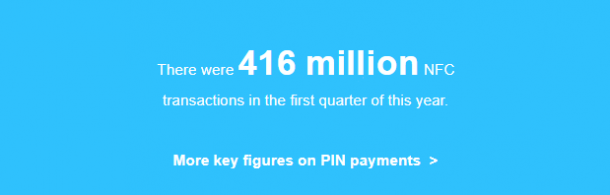
- Figures
- Agenda
Mobile payment as popular as cash at points-of-sale in 2022
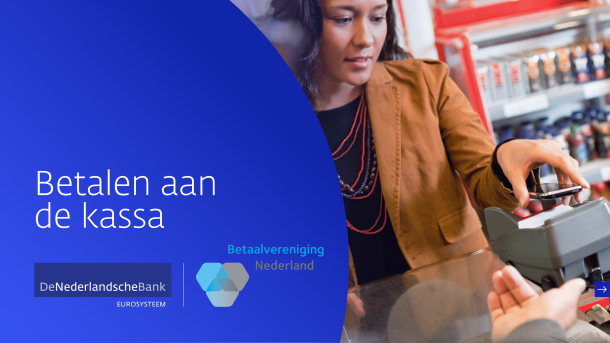
In 2022, cardless payments with smartphones and wearables were as popular as cash at physical points-of-sale in the Netherlands, with a 21% share for cardless debit card payments and 20% for cash. Debit card payments, including all contactless and cardless variants, account for 80% of all payments at the physical counter.
The Payments at Points-of-Sale 2022 report by De Nederlandsche Bank (DNB) and Betaalvereniging Nederland shows that in particular adolescents, over-65’ers and those struggling to make ends meet are sticking with cash payments. The use of cash seems to have stabilised after corona, while new cardless payment instruments, such as mobile phones and wearables, are gaining popularity. People who are struggling to make ends meet are more likely to pay cash, which helps them to limit their spendings.
More information about point-of-sales in 2022
New task force focuses on implementation of European Accessibility Act
Dutch banks are continuously working on improvements for vulnerable people such as seniors or people with disabilities, so they can continue to pay and bank autonomously and avoid being financially excluded. Recently, banks even issued a Commitment on this, following a recent DNB survey.
(More) inclusive society
The Payments Association has been looking closely at how it could coordinate the implementation of the guidelines from the European Accessibility Act. In March 2023, the Payments Association decided to convert the Working Group on Accessibility and Inclusion (WTI), established in June 2020, into the Taskforce European Accessibility Act (TFEAA). The TFEAA includes representatives from ABN AMRO, ING, Rabobank, Triodos and de Volksbank, as in the former WTI. De Nederlandsche Bank is an observer.
Read more about the themes and goals of the TFEAA.
Open banking event ‘SPAA: open access beyond PSD2’
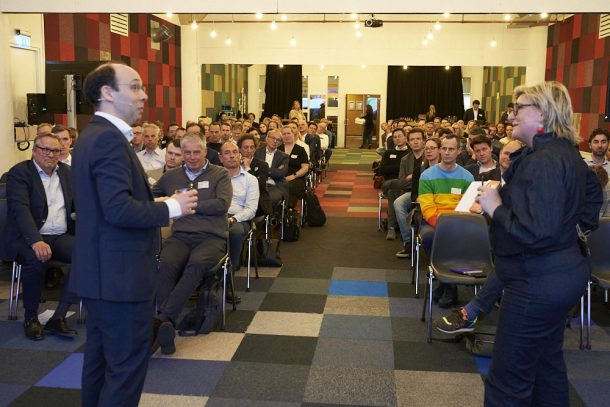
On April 18th the Dutch Payments Association (Betaalvereniging Nederland) hosted its ‘SPAA: open access beyond PSD2’ event, with presentations and discussions on the latest developments and opportunities for open banking in the Netherlands. Almost 150 bankers, PSP’s, regulators, consultants and merchants attended the event that was moderated by Silvia Mensdorff-Pouilly, Head of Corporates & International Banking at FIS, board member at EWPN and at the Payments Association.
The event kicked off with an insightful presentation on the current state of open banking in the Netherlands, by Hessel Kuik, chairman of PSD2SIG and CEO of Bizcuit. He showed that open banking has not yet fully caught on, but the industry has moved in the right direction. Charles Damen, chairman of the Open Banking Working Group at UK Finance and CPO at Token, provided insights on how open banking is shaped in the UK. Emanuel van Praag, Professor of Financial Technology and Law at EUR and Attorney-at-Law at Kennedy van der Laan, offered a broad vison on open banking and open finance: where will financial data sharing go in the future? Gijs Boudewijn, co-chairman of the SPAA multi-stakeholder group and director of the Payments Association, guided the audience through the latest developments for the SEPA Payment Account Access (SPAA) scheme.
The official program was concluded with an animated panel discussion on the SPAA scheme with Jan van Vonno, head of strategy at Tink, Atze Faas, payments advisor at EuroCommerce, Gijs Boudewijn and Silvia Mensdorff-Pouilly. The panel members voiced their concerns and expectations on how SPAA and Open Banking should move forward, from the perspective of banks, PSPs and merchants.
Check out our event coverage with photos on our dedicated page
Successful migration to T2, the new euro real-time gross settlement system
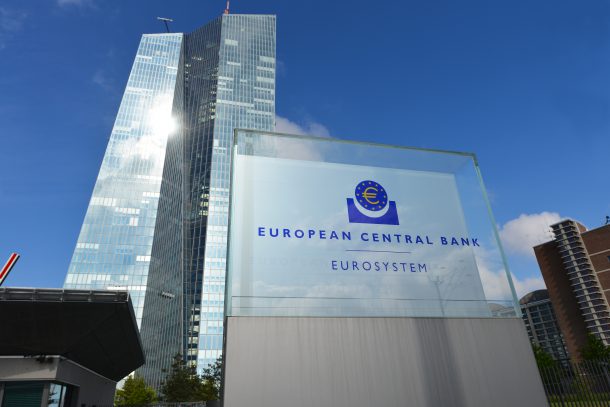
The Euro system successfully implemented the new T2 euro real-time gross settlement system over the weekend of 18 and 19 March. The migration was smooth and also required banks and transaction processors to migrate their systems. On 20 March, T2 successfully processed the usual daily volume of about 400,000 transactions.
Dutch banks and transaction processors also transitioned smoothly, thanks to thorough preparations and testing assisted by De Nederlandsche Bank (DNB) and Betaalvereniging Nederland. The T2 system handles real-time gross settlement of euro payments between banks within the eurozone.
More information on the successful Target 2 migration
Final farewell to Acceptgiro
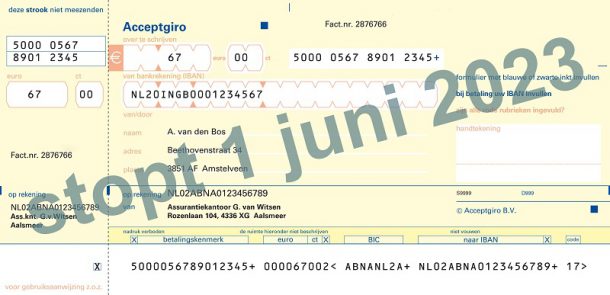
On May 31st, the last paper Acceptgiro will be processed in the Netherlands. The Acceptgiro was jointly introduced by banks and the (no longer existing) Postcheque- en Girodienst (PCGD) in 1977. It was the successor to the ‘Stortings- en Acceptgirokaart’ (or STAC card, a punch card).
In the heydays of Acceptgiro, more than 300 million paper forms were processed annually. By 2023, the volume will be a mere 0.3% of that number.
Since the 1980s, the Acceptgiro form was blue. There was also a green variant, the ‘Actie-Accept’. This could only be used for charity donations.
With the introduction of the euro on 1 January 2002, the blue form was replaced by the yellow euro Acceptgiro form and the green version for donations to charities was abolished.
In 2014, the form was updated one more time for the IBAN (International Bank Account Number). The old seven- or ten-digit domestic account numbers gave way to the 18 digits and letters of the Dutch IBAN.
Both companies and individuals appear to have replaced Acceptgiro with one or more alternative payment methods. These alternatives include paper bank transfer forms, direct debit mandates, on paper or digitally, iDEAL with QR code.
As of 1 June 2023 Acceptgiro forms can no longer be submitted on paper to have funds transferred from one payment account to another. Like the cassette tape, the Acceptgiro will the hall of fame of iconic but discontinued information carriers.
Dutch consumers spent €33.3 billion online in 2022
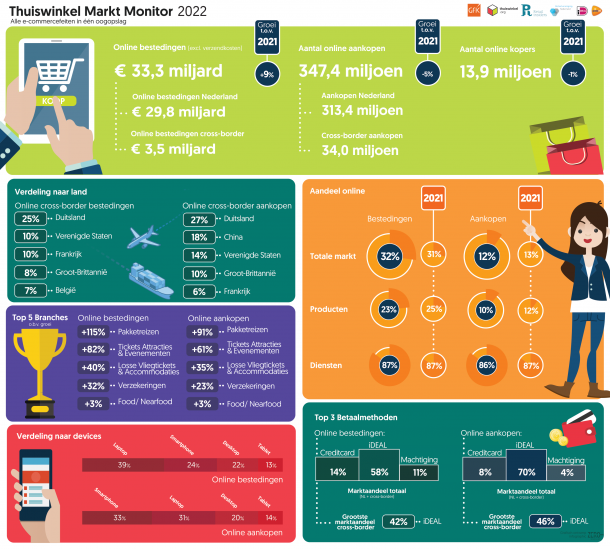
Dutch consumers spent €33.3 billion on online purchases in 2022, up 9% compared to 2021. Figures from the Thuiswinkel.org Market Monitor show that the number of purchases decreased by 5%, while the average amount spent per purchase increased by 15%. Online purchases and spending on services increased, while those for products decreased.
The popularity of online shopping remained stable. The share of online purchases in total spending grew from 31% to 32%. The number of online purchases using smartphones rose from 29% to 33% and iDEAL remained the most widely used payment method, accounting for 70% of online purchases.
More information on online spending by Dutch consumers
Proposed bill from European Commission for Instant Payments

The European Commission published a legislative proposal on instant payments (a regulation) on 26 October 2022. Instant payments are to become the new normal in the EU. The Commission proposes to make instant payments mandatory for payment service providers already offering regular credit transfers (SCTs), to prohibit surcharges, to make confirmation-of-payee mandatory and to make sanction screening simpler. An exception is included for (non-bank) payment and electronic money institutions.
The Payments Association, together with its members, has responded to the European Commission’s consultation and recommends some adjustments to the proposal:
- Require payment service providers supporting SCT to make at least one digital interface available for sending instant payments;
- Leave using instant payments for business payment batches to the market;
- Require payment service providers to only offer an opt-out for confirmation-of-payee when the customer is charged for the service;
- Remove the requirement to support instant payments for providers serving a specific market segment with little or no demand for instant payments;
- Extend implementation timelines and deadlines.
The European Parliament is currently debating the bill. Envoy Michiel Hoogeveen has already published his draft report. The legislative process around this topic is moving quickly and the final bill is expected to be tabled in autumn 2023.
The Payments Association’s roadmap: here’s what we will do over the next three years

As we do every year, we have published our roadmap of topics and activities. In this roadmap, we look three years ahead (2023-2025) at the main developments that could or would affect our sector and us. This version of the roadmap also translates the expected developments into our Year Plan 2023.
U kunt de volledige roadmap downloaden en lezen.
EPC country profile: how does the Dutch payment system compare to the rest of the EU?
Gijs Boudewijn discusses Dutch payments in a country profile, as part of a series by the European Payments Council (EPC). The profile covers key features and recent developments of the Dutch payments landscape and looks at topics such as instant payments, confirmation -of-payee and the costs and revenues of payment services in the Netherlands.
What is not reflected in the EPC’s standard diagrams: debit card payments account for 80% of all Dutch physical point-of-sale payments, while 70% of Dutch online payments are made with iDEAL.
Read more about the Dutch EPC country profile
Association news
We welcome our newest member, XXImo Financial Services. They are active as a Dutch electronic money institution in mobility solutions and as an issuer of payment cards. Welcome!
On May 17th, the semi-annual General Members’ Assembly of the Dutch Payment Association will take place. Members will soon find the invitation and related meeting documents in our portal Infonet. Following the meeting, there will be an informative session on the implementation of the accessibility program in response to the commitment issued by the banks at the end of January. The session will be held at our office in the Auditorium.
Figures
Agenda
- May 8th – Giro Information Meeting
- May 17th – General Members’ Assembly
- June 6th – 8th – Money20/20
- June 12th – Stakeholder Meeting
Member Bulletins
In addition to this Betaaljournaal, the Dutch Payments Association issues Member Bulletins. These bulletins usually appear a few times a month and relate to a specific topic. If you are a member and you do not yet receive these bulletins, you can subscribe to the mailing list via secretariaat@betaalvereniging.nl.
Subscribe to Betaaljournaal
For the latest developments in payments, stay informed via Betaaljournaal. You can register here: