
Betaaljournaal 10
Newsletter Dutch Payments AssociationOn Thursday 20 May we hosted two online meetings: our General Assembly and ‘The Weakest Link’, a webinar that focused on security, which is one of our key focus points for this year. Although we would have preferred to meet members in person, I was pleased that so many were participating online. Wiebe Draijer, Chairman of the Executive Board of Rabobank, informed us about the work of the Cyber Security Council. We also had speakers from the Public Prosecution Department (Jacqueline Bonnes) and ING (Boudewijn van der Valk), while our own Marco Doeland told us about the activities of the Dutch Payments Association on this topic. For those who want to know what ethical hacker Stan Hegt and behavioral scientist Inge Wetzer think about ‘the weakest link’, I warmly recommend betaalTV. In this edition of Betaaljournaal you can also read about bailiffs, money mules, increasingly digital seniors and DORA.
Gijs Boudewijn, Director ad interim
In this edition:
- End-to-end tests TARGET2 Consolidation
- WhatsApp scammer can expect bailiff
- Webinar Money Mules
- Corona propels relative debit card usage in 2020
- More and more elderly people pay digitally
- Update Secure Banking – Loes Romeijnders
- Figures
- Results National Forum on the Payment System (NFPS)
- Digital Operational Resilience Act
- Three new types of fraud published on veiligbankieren.nl
- Checking in with Stephan Hoes
- Agenda
- More events and activities
- Association news
End-to-end tests TARGET2 Consolidation
At the end of 2022 Europe will switch to the new TARGET2 environment. For payment traffic this means connecting to the new infrastructure and switching from the old MT messages to XML. A complex operation in which the switch will also be carried out as a big bang implementation.
Every bank with an account in TARGET2 will have to deal with this migration and make preparations. The ECB and DNB coordinate the process for the Netherlands. Because of the high risk of failure, DNB is keeping a close watch and will be monitoring the banks’ progress every quarter. In addition, each bank must complete a mandatory test procedure to demonstrate that they can exchange the new XML messages, based on the ISO20022 standard. Read the full article (in Dutch) or contact us for more information at giraal@betaalvereniging.nl.
WhatsApp scammer can expect bailiff
Scammers are no longer anonymous! Since the beginning of this year, victims of fraud can obtain the name and address of a scammer under specific conditions. This allows them to engage bailiffs to recover the money that they transferred to an account holder under false pretenses.
Procedure for bailiffs
Bailiffs that are member of the national association of bailiffs (LAVG in Dutch) have been visiting beneficiaries of WhatsApp frauds’ homes since a few weeks to recover the misappropriated funds. The beneficiary is thus confronted in person with his crime. In addition to the original funds, compensation for damages and expenses is added to the claim. If the beneficiary pays the bailiff’s bill in time, the bailiff can ask the Public Prosecution Department to stop criminal prosecution. Hopefully this will help to reduce these scams and to convince more scammers to refund victims. If you want to know more about this procedure, please contact Renske Vlek, r.vlek@betaalvereniging.nl.
Webinar Money Mules

On Thursday 22 April VAR (the Rotterdam Safety Alliance), police, public prosecutors, national competence center LVB (for people with a minor disability) and the Dutch Payments Association hosted the webinar Money Mules for Care Professionals. No less than 850 counselors of vulnerable youngsters participated in the live webinar. The webinar encourages them to inform their clients and identify signals that clients are recruited as money mules. An additional 1600 care professionals watched the recorded webinar video. Watch the video yourself and read the presentations (in Dutch).
Corona propels relative debit card usage in 2020
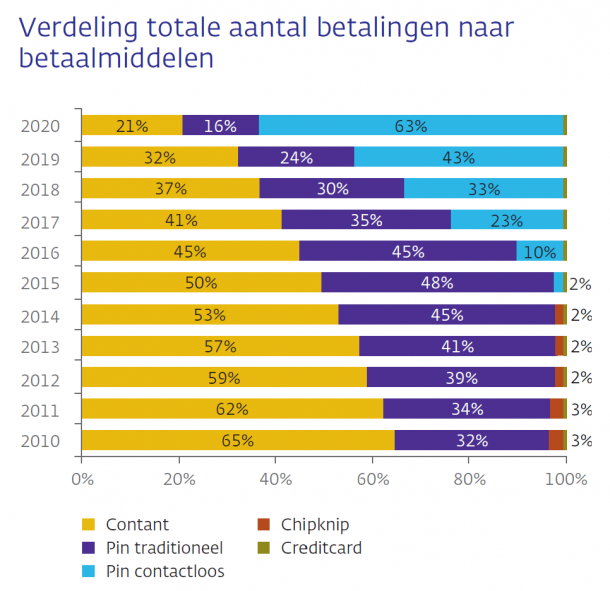
By 2020, consumers in the Netherlands paid 79% of their purchases in stores, restaurants etc. with a debit card, smartphone or wearable. This is a substantial increase compared to 2019. As a result of these shifts in payment behavior, in 2020 consumers paid more often with debit cards than with cash in all retail sectors for the first time. Partly due to the COVID-19 pandemic, the Dutch also paid more purchases contactless. Not only the use of cash but also using debit cards to insert them into payment terminals, has declined more than in previous years. This is the conclusion of the Payments at Points-of-Sale 2020 report of the Dutch Payments Association and the Dutch central bank. See the full fact sheet.
More and more elderly people pay digitally
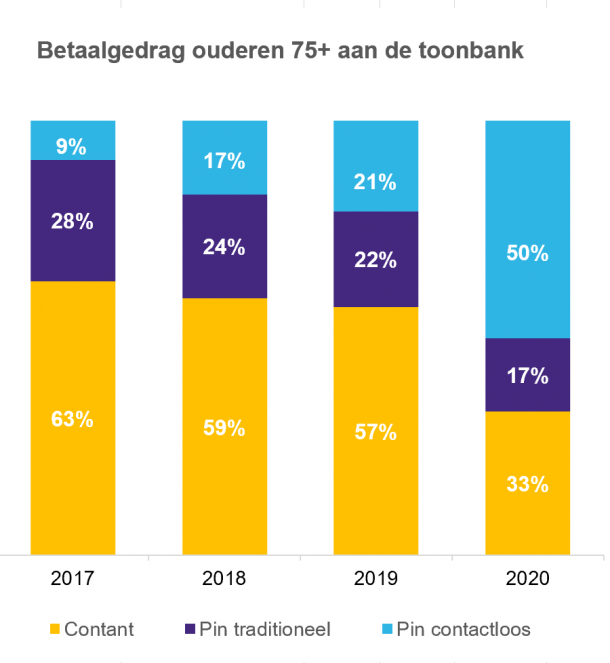
The elderly seemed to stay behind in paying with debit cards in recent years. They generally preferred to pay for their groceries in cash. That’s what they were used to and they liked it just fine. Due to COVID-19 people over 75 changed their payment behavior: the Payments at Points-of-Sale 2020report shows that during the first lockdown starting March last year, they too started to pay contactless instead of cash. On top of that – now that this hurdle has been overcome – this ‘new’ payment behavior seems to have taken hold with most elderly. While some Dutch have reverted to payment behavior that was common before COVID-19 at the end of 2020, seniors still pay twice as often with their debit card. Whether this will remain so when the impact of COVID-19 diminishes, remains to be seen. The preliminary results of the survey in 2021 have not yet shown any decline in debit card use by people over 75. The new payment behavior may have become completely normal to them.
Update Secure Banking – Loes Romeijnders
Through Secure Banking (Veilig Bankieren), consumers are given advice how to be secure in payment transactions and to prevent fraud. This year the Secure Banking Task Force is targeting young people with a new campaign. Loes Romeijnders, communications advisor at the Dutch Payments Association explains (in Dutch).
Figures
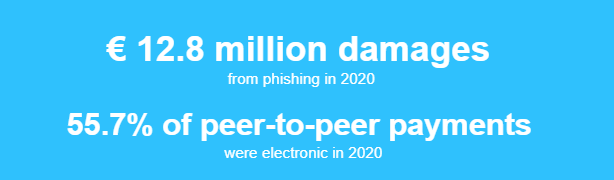
More figures? Visit factsheet.betaalvereniging.nl
Results National Forum on the Payment System (NFPS)
The NFPS meeting on May 20, 2021 discussed, among others, the
results of the Accessibility Monitor 2021 and the action plan of the Working Group for Accessibility and Inclusiveness (WTI Dutch Payments Association) and Working Group Accessibility and Reachability of the National Forum on the Payment System (the MOB, in Dutch) to improve the accessibility of payment services for vulnerable groups. For most consumers, the accessibility and reachability of payment services is still good and even improved in some areas. However, some of the vulnerable groups (such as people with a physical or mental disability, the elderly, people who are less digitally literate or who do not have access to the internet, the poorly educated) experience a deterioration, including to their independence in carrying out day-to-day banking and payments. Therefore, the MOB has adopted an action plan. Read the full document here(in Dutch). Other topics in the consultation were developments in the accessibility and acceptance of cash, fraud and the leniency of banks with caller-ID spoofing.
Digital Operational Resilience Act
 On September 24, 2020, the European Commission published its long-awaited draft regulation on digital operational resilience for the EU financial services sector, the Digital Operational Resilience Act (DORA). The proposal is the first legislative initiative to establish a harmonized and comprehensive framework for the digital operational resilience of European financial institutions. Once DORA is formally adopted, critical third parties – such as cloud computing services – will also come under the direct supervision of European supervisory authorities. The Payments Association has responded to the draft legislative proposal on behalf of its members. Read the full response here.
Three new types of fraud published on veiligbankieren.nl (in Dutch)
- WhatsApp hacked, now what?
Hacking a WhatsApp account is the hijacking of a WhatsApp account by a fraudster. The fraudster then gains full control of the account and can access all WhatsApp contacts as if he or she were the legitimate user. - Beware of text messages, supposedly from a parcel service!
In recent weeks, more and more people receive a message on their cell phone, supposedly from a parcel service or from a store. The message tries to convince the recipient that a package is on its way and that the recipient should install a mobile app to arrange delivery and track the package. However, that is a malicious app. - QR-code scams
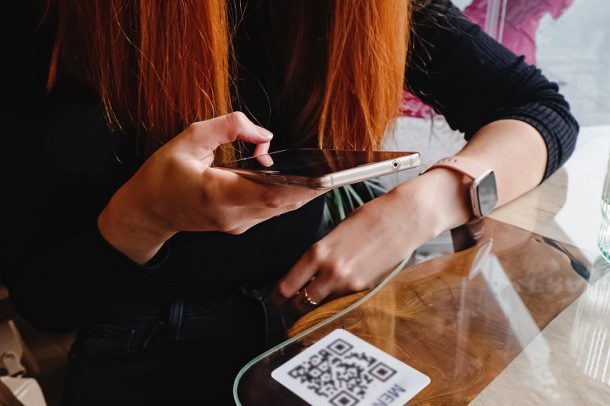
The police, the Fraudehelpdesk and various media outlets have recently warned against phishing and fraud using QR codes. There are two types:
1. A person or company asks you to scan a generic QR code, either with a random QR scanner or with the standard camera of your smartphone or tablet. That QR code usually opens your web browser and may show a fake website, supposedly from your bank or another well known organization, for example from the Tax Department or from DigiD.
2. A person or company asks you to scan a special QR code with the mobile app of your bank or of a payment service such as Tikkie. Via this QR code, the fraudster tries to get you to pay something or gain direct access to your bank account.
The Secure Banking website offers consumers advice on how to avoid falling victim to these types of fraud.
Checking in with Stephan Hoes
Stephan Hoes is Innovation Lead at ICS Cards. He takes us through his specialty and what makes him tick in his profession.
Agenda
- Each month – Workshop Quantum computers
- 28 – 30 June – EBAday 2021
- 9 September – Future of Payments (in Dutch)
- 21 – 23 September – Money 20/20
- 18 November – Annual Conference 2021
More events and activities
- Quantum computers and cyber security: “Get your hands dirty!”
(in Dutch) - Annual Report 2020
- betaalTV 3 2021: Main topic “security” (in Dutch)
Association News
- The Annual General Assembly held on 20 May appointed Narjiss Aydoun, Head of payments and cards at ING, as a member of the board on behalf of ING. She succeeds Frank Stockx who has returned to Belgium. This AGA also approved the 2020 annual accounts and the presentation of the annual report.
Member Bulletins
In addition to this Betaaljournaal, the Dutch Payments Association issues Member Bulletins. These bulletins usually appear a few times a month and relate to a specific topic. If you are a member and you do not yet receive these bulletins, you can subscribe to the mailing list via secretariaat@betaalvereniging.nl.
Subscribe to Betaaljournaal
Also curious about the latest developments in payments? Stay informed via Betaaljournaal. You can register here: