
Betaaljournaal 6
Newsletter Dutch Payments AssociationSecurity
In October there is always a great deal of attention for the subject of security. The dark winter days are approaching and criminals are on the move again. The Secure Banking campaign has planned various activities this month. In addition, the Dutch Payments Association is getting ready for two webinars and its annual conference. I wished I could meet you in person during these events, but unfortunately that is not (yet) possible. Meanwhile I am looking forward to better times ahead. I hope you sign up for these events, because we intend to offer you great online programmes! In this Payment Journal you can also read about DDoS attacks, disruptions and the relationship between telecom and the payment system. Anjeni Bedi from CM.com talks on camera about her work as a compliance officer. Enjoy reading and watching!
Piet Mallekoote, Director
In this Betaaljournaal:
- Secure Banking during October security month
- DDoS attacks thwarted through joint response
- Check out Anjeni Bedi
- “No harrassment intended”
- Webinar: Developments and preparations for SWIFT/ECB/DNB ISO 20022 migration tracks
- Online payment services cannot operate without reliable telecom networks
- Infographic New Dutch Citizens
- Accessible banking products and web sites
- Establishing PI-ISAC to increase cyber resilience of payment institution
- Update on disturbances
- Agenda
- Stats
- More events and activities
Secure Banking during October security month
We are back on TV with Secure Banking! The new commercial (in Dutch) of the banks and Dutch Payments Association launched during this year’s Security Week. The Payments Association frequently communicates about secure banking with our ambassador Marc. He plays a central role in our communications, informs the public about the tricks of criminals and gives prevention tips. The commercial includes a banner campaign jointly developed with the Dutch banks. Marc tells us that www.veiligbankieren.nl is the leading website to stay informed about payment frauds and scams and what you can do about them.
By the way, the website has been redesigned for a better user experience on various devices and has been updated with two new online videos(in Dutch). These videos are about the collective banking security rules and how criminals rapidly hijack current events to mislead consumers.
DDoS attacks thwarted through joint response
 Dozens of companies and organisations were recently attacked with DDoS (Distributed Denial of Service). These are attacks on banks and other digital service providers. Disturbances for the customers of these organisations were limited through cooperation and joint countermeasures.
With a DDoS attack cyber criminals try to make a website, server or online service inaccessible. For example, with a botnet – a centrally controlled very large network of hacked computers – an online service is overloaded by a massive number of service requests. As a result, normal customers can no longer access the online service.
Read the full article…
Check out Anjeni Bedi
We check out Compliance Officer Anjeni Bedi on her job at CM.com.
“No harrassment intended”

Every financial institution has a regulatory obligation to thoroughly screen his customers and monitor their transactions. This KYC obligation (Know-Your-Customer) applies to all financial institutions, such as banks, payment institutions and insurers. Piet Mallekoote: “That is the reason banks and payment institutions request personal and business details from their customers, both from new customers and existing customers. The latter often find this odd, as they have been doing business with their bank or payment institution for a long time and suddenly need to verify and supply all kinds of additional information. It feels like distrust but it is not intended as harassment of customers by banks and payment institutions. It is to work together to keep payment transactions safe and comply with stricter anti-fraud legislation”. Read full article…
Webinar: Developments and preparations for SWIFT/ECB/DNB ISO 20022 migration tracks
The worldwide deployment of the ISO 20022 standard for financial messages is gaining momentum. This standard contributes, amongst others, to faster processing of transactions, fewer errors and allows for more data in a single message. Two specific ISO 20022 migrations are notably relevant to the Netherlands. Both TARGET2 (for payments between SEPA banks) and SWIFT (for cross-border transactions, worldwide) are migrating to IS 20022. In addition, the EPC is investigating different migration scenarios for all the SEPA payment schemes to use the latest version of ISO 20022. This requires a lot of work for payment service providers. More information can be found here (in Dutch).
On 27 October from 12h00 to 13h30 we will organise “ISO 20022 for lunch”, a live webinar about the developments for SWIFT and TARGET2, and the technical implementation at banks. An invitation with the programme will follow in a Member Bulletin.
Online payment services cannot operate without reliable telecom networks

The Dutch Payments Association conducted a study in 2020 into the dependency between payment services and telecom networks. The study focuses on the situation in the Netherlands, but also in neighbouring countries. What have banks and payment institutions already done and what more can be done to ensure that ultimately consumers’ electronic payments never fail? This can be achieved with sound agreements with the telecom industry, but also by offering alternative payment solutions in the event of disruptions. Despite the very high reliability of the telecom infrastructure in the Netherlands, disruptions can occur on rare occasions.
You can read more on this subject on our website (in Dutch).
Infographic New Dutch Citizens
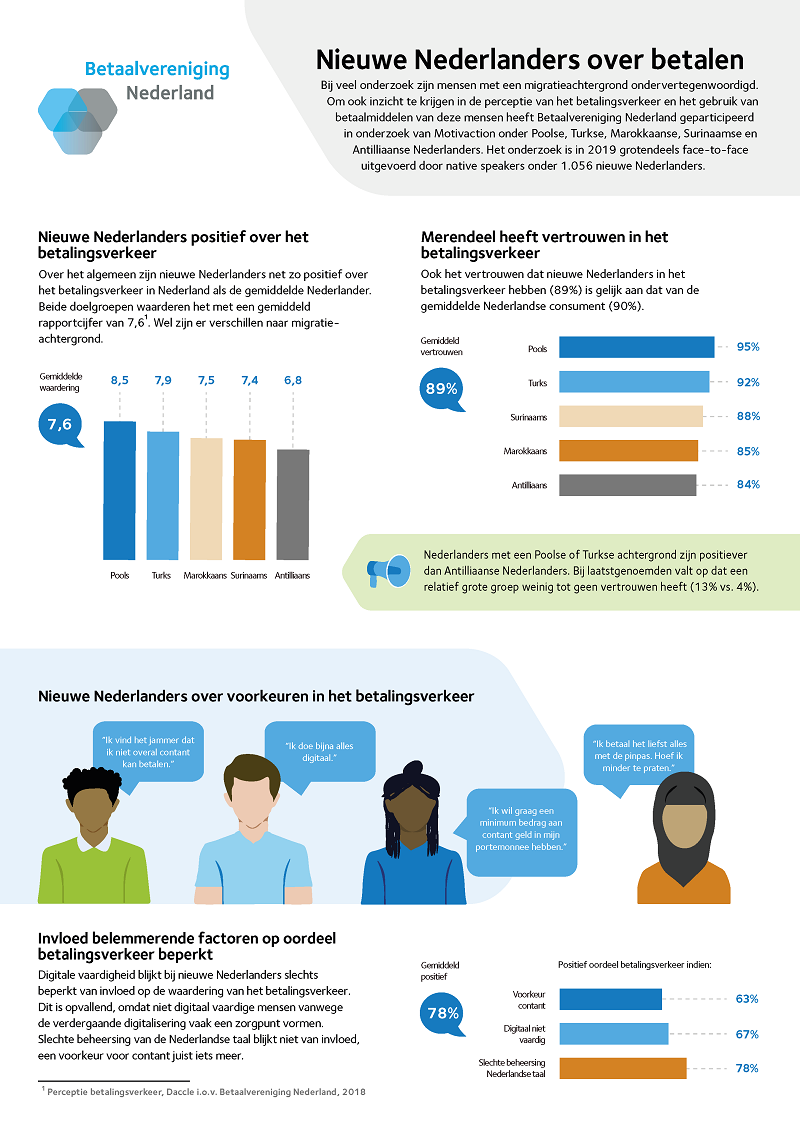
In many studies, people with a migration background are under-represented. In order to gain insight into the opinions on the payment system and into the preference for specific payment methods of immigrants, the Dutch Payments Association joined a study by Motivaction among Polish, Turkish, Moroccan, Surinamese and Antillean Dutch citizens. The survey was largely conducted in person, in 2019, among 1,056 new Dutch nationals, in each respondent’s mother tongue.
Accessible banking products and web sites
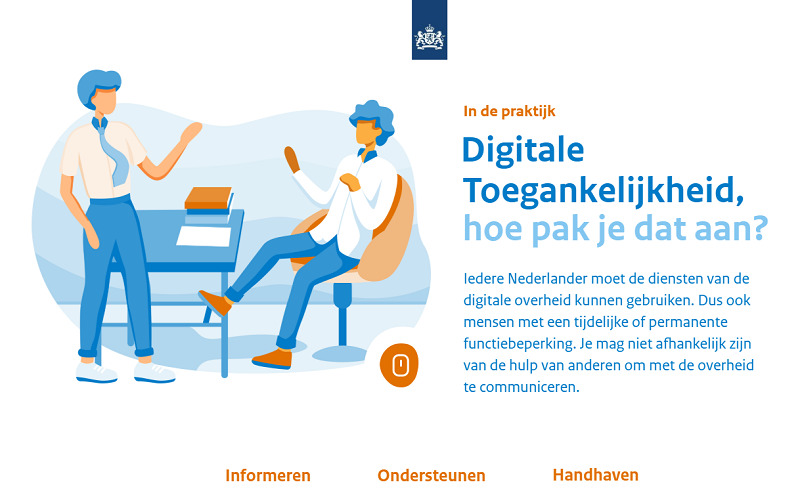
Recently, the magazine Digital Accessibility, how do you do that? (in Dutch) was released online. The magazine shows how to tackle digital accessibility with three main directives: inform, support and enforce. It also looks at how government organisations apply this(in Dutch).
Establishing PI-ISAC to increase cyber resilience of payment institution

On 30 June, the Dutch Payments Association, some of its members and the Digital Trust Center set up a new fraud and cyber security consultation for payment institutions: the Payment Institutions Information Sharing and Analysis Centre (PI-ISAC). The PI-ISAC is a periodic meeting for cyber security, fraud and AML specialists within the payments sector. A similar consultation already existed for financial institutions pertaining to the core financial infrastructure, the FI-ISAC.
Increase resilience
The main purpose of the PI-ISAC is the (confidential) exchange of information on cyber security, fraud and AML-related incidents, threats, vulnerabilities and best practices. This enables participants to increase the resilience of their own organisation and contribute to that of the sector as a whole. The focus of the topics is currently on cyber security and fraud.
For more information about the cooperation or for participation, please contact Alice van den Wittenboer at pi-isac@betaalvereniging.nl.
Update on disturbances
Frans Persijn is Product Consultant Cards & Cash at the Dutch Payments Association. He tells about his job when a major disturbance occurs in the Dutch card payments infrastructure.
Agenda
- 27 October – 12h00: Webinar ISO 20022 for lunch.
Invitation for DPA members follows soon. - 27 October – 15h00: Webinar 15 years iDEAL: Payments in other realities (AR & VR). Invitation for iDEAL business relations follows soon.
- 12 November – 14h00: Annual conference Dutch Payments Association.
Save-the-date was mailed to invitees.
Stats

More stats? Go to: factsheet.betaalvereniging.nl
More events and activities (in Dutch)
- BetaalTV on cash after corona
- Webinar with The New Marbles
- Update Corona Bulletin
- Publication in Journal of Payments Strategy and Systems on Quantum Computing – Oscar Covers and Marco Doeland
Member Bulletins
In addition to this Betaaljournaal, the Dutch Payments Association also issues Member Bulletins. The bulletins usually appear a few times a month and relate to a specific theme. If you are a member and you do not yet receive these bulletins. You can subscribe to the mailing list via secretariaat@betaalvereniging.nl.
Subscribe to Betaaljournaal
Also curious about the latest developments in payment transactions? Stay informed via Betaaljournaal. You can register here: